







17 Instagram scams to know and avoid
Instagram scams take many forms, from phishing messages and fake giveaways to impersonation and blackmail. This guide will help you spot, report, and avoid scams on Instagram. Then, for extra protection online, consider using Norton 360 Deluxe, which comes with AI-powered scam detection and advanced antivirus tools.




- 1. Fake influencer accounts
- 2. Phishing message scams
- 3. Fake job scams
- 4. Fake sponsorships
- 5. Lottery and giveaway scams
- 6. Crypto scams
- 7. Romance scams
- 8. Investment scams
- 9. Fake product scams
- 10. Paid subscription scams
- 11. Blackmail scams
- 12. Instagram ad scams
- 13. Muse scams
- 14. Charity scams
- 15. Loan scams
- 16. Music promotion scams
- 17. Commission scams
- How to spot scammers on Instagram
- How to avoid Instagram scams
- What to do if you get scammed on Instagram
- Scroll safely with Norton
- FAQs
You may encounter more than just eye-catching pictures and entertaining videos on Instagram. A recent investigation by The Wall Street Journal found that Meta has struggled to contain a rise in fraud across Facebook and Instagram — a challenge faced by nearly every online platform.
While Instagram has security measures in place, scams can still slip through the cracks. To help you avoid getting duped, we've rounded up the 17 most common Instagram scams along with tips to avoid falling for them.
1. Fake influencer accounts
Influencer scams involve fake or hijacked accounts posing as popular figures to build trust. These scammers often promote dodgy investment opportunities or financial services, using inflated follower counts to appear legitimate.
Their ultimate goal is to steal your money or personal information. They may direct you to phishing websites that capture login credentials, ask for payment through untraceable methods like cryptocurrency, or request sensitive details under the guise of a giveaway or investment opportunity.
2. Phishing message scams
Instagram phishing messages are deceptive DMs or emails that impersonate Instagram support. They often warn of suspicious activity or imminent account suspension and include a link or request for personal information, such as your username and password. The scammer’s goal is to steal your credentials, take over your account, and potentially target your followers with further scams.
Common phishing messages might say:
- “Your Instagram account will be deleted in 24 hours due to copyright violations. Click here to appeal.”
- “Unusual login attempt detected. Verify your identity immediately.”
- “You’ve been reported for breaking Instagram’s community guidelines. Log in to resolve this.”
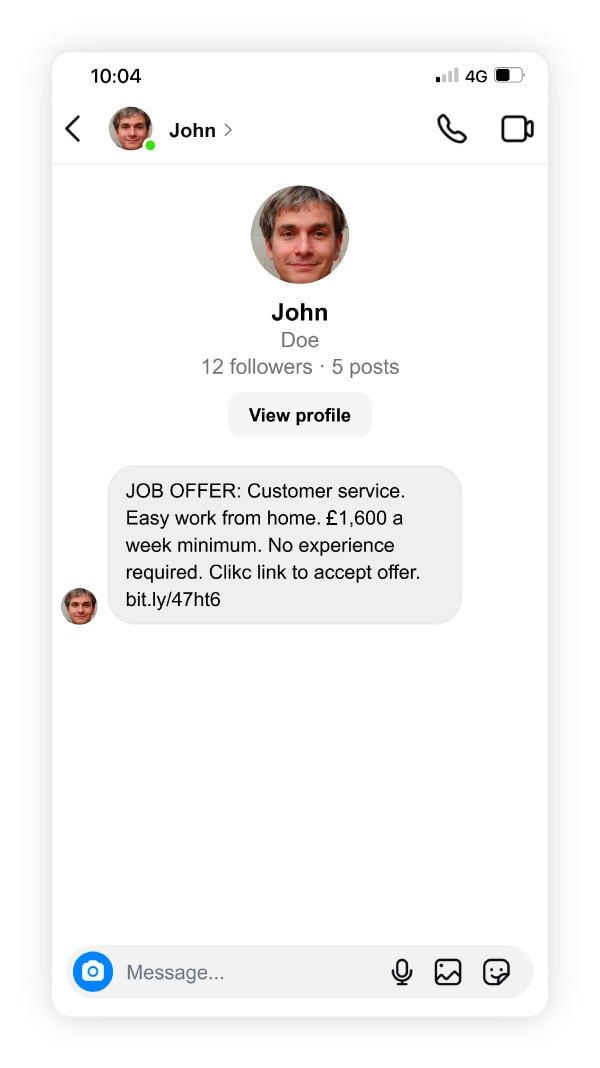
3. Fake job scams
Fake job scams on Instagram often begin with a fake job posting that promises easy money for minimal work. Scammers pose as recruiters and direct you to phony applications, or message you directly asking for personal details like your contact info or SSN.
The goal is usually to steal your identity or hijack your Instagram profile. But some fake job listings are designed to steal money. In these scams, you’re usually asked to pay a fee to cover costs related to onboarding.
4. Fake sponsorships
Fake sponsorship scams target popular Instagram creators, especially micro-influencers, by impersonating legitimate brands and offering opportunities to promote products or become brand ambassadors.
These scammers send DMs promising payment, free trips, or exclusive deals, but then ask for personal and financial information to steal your identity or money.
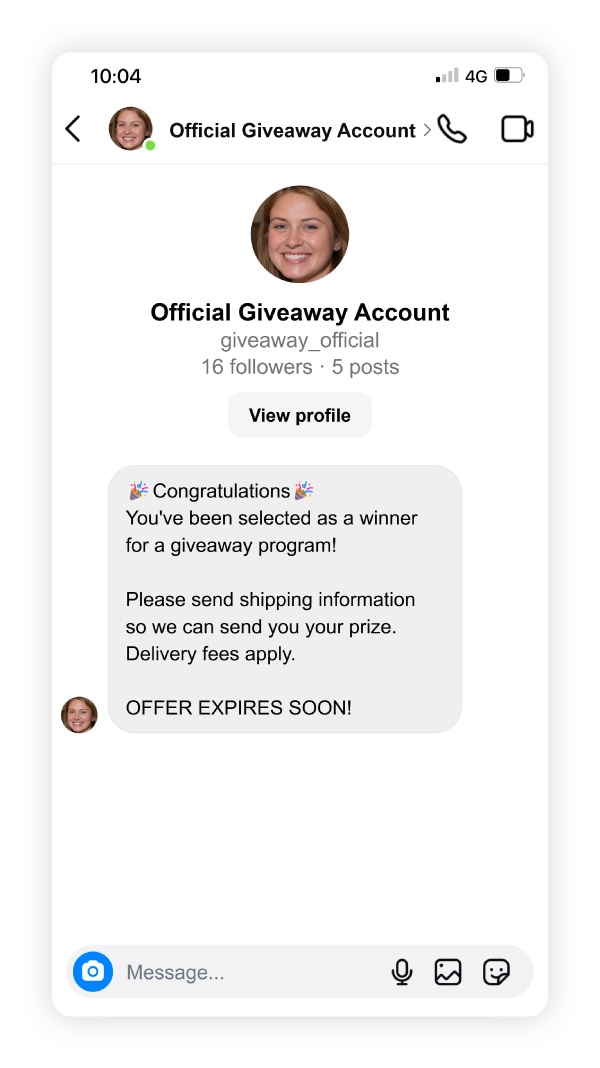
5. Lottery and giveaway scams
Instagram lottery scams trick users into believing they’ve won a large cash prize from a random giveaway, claiming they were selected from a pool of followers. They then ask for personal details, followed by payment for “delivery fees” or “processing costs” through gift cards or cryptocurrency. The real aim is to exploit your excitement to steal your money or gather enough personal data to commit identity theft.
One Reddit user in the US shared how they were duped by a fake $30,000 lottery prize after receiving a DM from an Instagram account named “Dave Johnson.” They were referred to a fake agent on WhatsApp, paid over $430 in Bitcoin for supposed delivery and processing fees, and never received any money.
6. Crypto scams
Instagram crypto scams prey on users eager to get in on the digital currency boom.
This scam starts by scammers sliding into your DMs claiming they can multiply your money if you invest. Then they ask for money, only to disappear with your funds.
7. Romance scams
Instagram romance scams usually involve catfishing by creating fake identities to build emotional connections and manipulate victims into sending money or sensitive information.
These scammers sometimes spend weeks or months gaining trust through messages and calls before asking for money, often fabricating medical expenses or pretending it’s for an airfare to visit you. Once you've sent them the money, they either disappear or try to exploit you for more funds.
But how can you tell if an Instagram account is fake? Here are some signs that your love interest may not be who they say they are:
- They avoid video calls or in-person meetings, often citing dramatic reasons.
- Their stories involve frequent emergencies like medical issues, legal trouble, or travel problems.
- They ask for money in forms that are difficult to trace or recover, like gift cards or cryptocurrency.
- Their profile photos look overly polished.
- They pressure you to move the conversation off Instagram quickly, often to WhatsApp or email.
One Australian man lost $40,000 over nearly two years to someone he believed was an American woman named “Charlotte.” She promised to move to Australia and marry him, but always had a new excuse for why she needed money, ranging from medical emergencies to airport arrests.
8. Investment scams
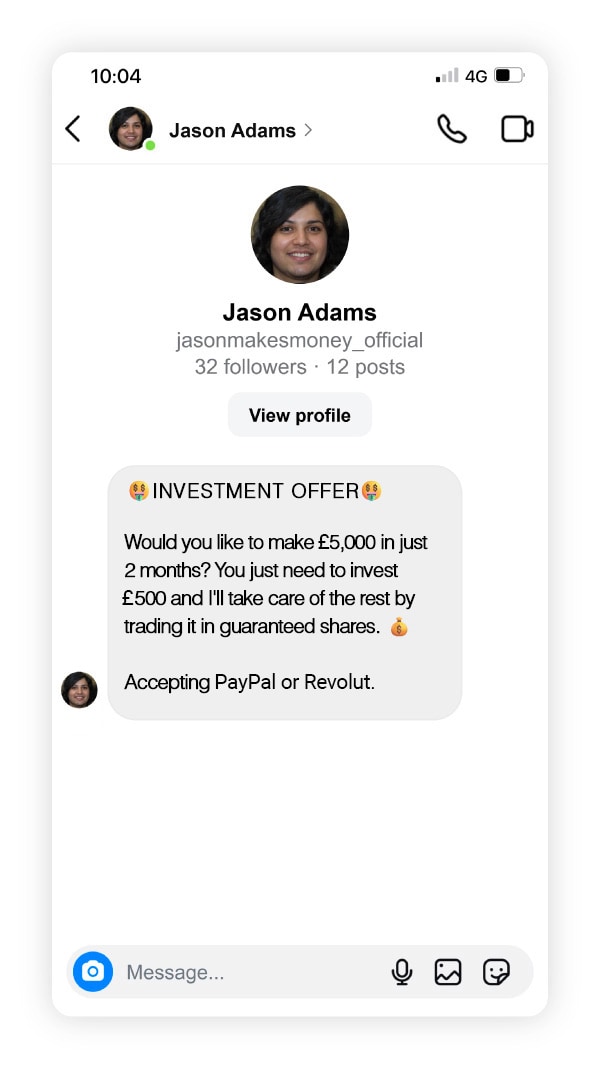
This Instagram money scam typically appears as a too-good-to-be-true opportunity, promising fast cash or guaranteed returns — much like crypto scams. It usually begins with a direct message from someone flaunting an extravagant lifestyle who urges you to invest through a mobile payment app in exchange for supposedly huge profits. The scammer’s real goal is to take your money and vanish, leaving you with no recourse.
9. Fake product scams
Instagram fake product scams trick users into buying items that are either cheap knock-offs or never arrive. These scams often originate from accounts with slick, professional-looking adverts, but include links to dodgy websites that request personal information and payment details.
They’ll typically insist on untraceable payment methods, such as cryptocurrency or gift cards, making it difficult to trace or recover your money. Their aim is simple: take your payment and vanish without ever delivering the promised product.
10. Paid subscription scams
Streaming deals are a favourite bait for paid subscription scammers. They’ll dangle dirt-cheap subscriptions to streaming services like Netflix or Spotify, and lure you to fake websites that convincingly mimic the real thing. The moment you enter your payment or personal info, they disappear. You’re left with nothing, and they’ve got the tools to commit identity theft or fraud.
11. Blackmail scams
Instagram blackmail often begins with flirtatious or explicit messages that quickly escalate into threats. Scammers may send suggestive photos and pressure you to respond in kind. If you do, they threaten to share the images with your contacts or post them online unless you pay.
In another variation, a scammer claims to have hacked your account and accessed private photos or messages. Whether the hack is real or not, the intent is the same: to extort money through intimidation.
12. Instagram ad scams
Instagram ad scams trick shoppers with fake adverts, often for luxury products, at prices that seem too good to pass up. These scams often link to spoofed websites, tricking users into entering their personal and payment information.
A recent Instagram ad scam involved fake Instagram adverts offering a sold-out £250 advent calendar from Space NK for just £28.99. Shoppers were directed to convincing copycat websites and ended up empty-handed.
13. Muse scams
In this scam, fraudsters impersonate artists and offer to pay for the rights to use your photos in a supposed project. They often approach you from hacked or professional-looking Instagram accounts to appear legitimate. If you agree, they’ll send you a cheque or voucher and ask you to return a portion of the funds to cover “material costs.”
The catch? The cheque or voucher is fake. Once it bounces, the money you sent is gone, and you could be left with an overdrawn account or additional bank fees.
One Reddit user recounted receiving a message from a hacked Insta account expressing admiration for their photos and offering $500 to use them in an art project. Excited by the opportunity, the user agreed, but was then asked to deposit several checks and send a portion of the money via Apple Pay and Zelle to cover “material costs.” The checks eventually bounced, leaving the user out of pocket.
14. Charity scams
Charity scams exploit people’s goodwill by posing as legitimate organisations or individuals in need. Scammers often create fake profiles that mimic real charities, posting emotional stories or images to convince people to donate. Their goal is to pocket your money rather than support any genuine cause.
15. Loan scams
Instagram loan scams lure victims with promises of instant approval, low interest rates, and quick cash in exchange for a small upfront fee. Once you make the initial payment, the scammer often vanishes or demands additional fees under false pretences, leaving you without the promised loan and out of pocket.
16. Music promotion scams
Music promotion scams on Instagram target musicians by offering fake promotional services in exchange for money. Scammers often send DMs from seemingly popular accounts, promising to boost your streams or promote your music. In reality, they use bot accounts to temporarily inflate views, likes, and follower counts — results that don’t lead to real listeners or career growth.
17. Commission scams
Instagram commission scams target artists by impersonating potential clients requesting custom work. These scammers often ask for personal details such as your payment information or home address, then follow up with fake checks, intentional overpayments, or phishing links disguised as payment confirmations. Their aim is to either convince you to send money back or gain access to your financial accounts.
How to spot scammers on Instagram
Common tactics scammers use to trick you into paying or providing personal info include creating a false sense of urgency and too-good-to-be-true offers.
What the experts say
"Stay alert, stay safe — and remember, real support never slides into your DMs." - Gen Blog, 2025
Luis Corrons, Security Evangelist
Here's a closer look at some red flags that you're talking with an Instagram scammer:
- Too-good-to-be-true offers: This could look like adverts for luxury products at extremely low prices or job offers with a high salary but no experience required.
- High follower count but low engagement: Many scam accounts artificially boost their follower numbers. If the account has thousands of followers but barely any comments or genuine interactions, it’s likely fraudulent.
- New account with few followers: Scammers frequently create new accounts, so a profile with minimal followers and a short history could be a red flag.
- Pressure to act quickly: Scammers often create a sense of urgency to stop you from thinking critically or verifying their claims. If you feel rushed, pause and reassess.
- DMs with links or personal requests: Be wary of messages asking you to click on links or share private information — these are common tactics for phishing or spreading malware.
- Poor grammar or strange phrasing: Scam messages often include grammatical mistakes or odd language that doesn’t feel natural.
- No personal content: A lack of real photos, stories, or posts about the person’s life usually indicates the account isn’t genuine.
- Comments full of bot-like replies: If the account’s posts have repetitive, generic, or irrelevant comments, it may be relying on bots rather than real engagement.
How to avoid Instagram scams
To reduce your chances of getting scammed on Instagram or other social media platforms, follow these cybersecurity best practice tips:
- Don’t click suspicious links: Instagram scammers often try to lure users to malicious websites. Avoid clicking on any link unless you’re absolutely sure it’s safe.
- Verify accounts before engaging: If someone claims to represent a brand or influencer, look for the blue verification badge next to their name. Without it, the account is more likely to be fake.
- Keep your account private: Limiting access to your content adds a layer of protection. Go to “Settings,” select “Privacy,” and toggle on “Private Account” so only approved users can see your posts and stories.
- Use a strong password: Protect your account with a complex password that’s hard to guess. This helps defend against password spraying and other takeover attempts.
- Don’t share personal information: Avoid sharing sensitive details like your address, phone number, or financial info that scammers can use to commit identity theft or craft more targeted scams.
What to do if you get scammed on Instagram
If you’ve fallen victim to an Instagram scam, it’s important to act quickly to help limit the damage. Here are the key steps to take to secure your account, protect your information, and prevent further loss:
- Change your passwords: Update your Instagram and any related account passwords to prevent unauthorised access.
- Enable two-factor authentication: Turn on two-factor authentication to add extra security to your account.
- Report the scam: Report the scammer’s profile and messages to Instagram and ReportFraud to help prevent them from targeting others.
- Run a virus scan: If you clicked a phishing link, you should run an antivirus scan to check for malware.
- Freeze your credit: If you shared sensitive financial information, freeze your credit to help stop new lines of credit from being opened in your name.
Scroll safely with Norton
Recognising common Instagram scams is a great first step toward staying safe online. But for ironclad, always-on protection, get Norton 360 Deluxe. With advanced, AI-powered scam detection and powerful anti-malware tools, it can help you identify and avoid threats not just on social media, but across the web. Start browsing, shopping, and scrolling with confidence today.
FAQs
Are Instagram adverts scams?
Not all Instagram adverts are scams, but some can be misleading or outright fraudulent. Before purchasing anything promoted in an Instagram ad, take time to research the company, read independent product reviews, and avoid clicking through the ad itself. Instead, type the business’s official URL directly into your browser to ensure you’re visiting a legitimate site.
How can I get my money back if I’m scammed on Instagram?
If you’ve been scammed on Instagram, report the fraud to your bank or payment service as soon as possible. They may be able to reverse the charge or open a dispute process, depending on the method of payment. However, recovery isn’t guaranteed, especially if you sent money via peer-to-peer payment apps or cryptocurrency.
Can people steal your information on Instagram?
Yes, scammers can steal your personal information on Instagram through phishing links, fake giveaways, impersonation accounts, and other deceptive tactics. This data can then be used for identity theft, account takeovers, or to tailor future scams with more convincing details.
Is security@mail.instagram.com legit?
Yes, security@mail.instagram.com is a legit email address Instagram uses to send security-related notifications such as login alerts. However, if the e-mail looks suspicious, remember that scammers can spoof legitimate-looking addresses. So, make sure to always verify the message by checking the “Emails from Instagram” tab in the Instagram app’s Settings.
What can I do if someone is impersonating me on Instagram?
If someone is pretending to be you on Instagram, you can report the account immediately to Instagram using in-app reporting tools, or via the browser if you don’t have an account. Keep in mind that Instagram may ask you for proof of identity before removing the fake account.
Instagram is a trademark of Instagram LLC.
Editorial note: Our articles provide educational information for you. Our offerings may not cover or protect against every type of crime, fraud, or threat we write about. Our goal is to increase awareness about Cyber Safety. Please review complete Terms during enrollment or setup. Remember that no one can prevent all identity theft or cybercrime, and that LifeLock does not monitor all transactions at all businesses. The Norton and LifeLock brands are part of Gen Digital Inc.




Want more?
Follow us for all the latest news, tips, and updates.